Skip to content

SibStudio Posts

Chickadee Miniature Painting

Posted in Art Work

Chickadee Miniature Painting

I have a new miniature painting up on my Etsy shop.

Black Capped Chickadee in the snow

Isn't he cute? We have Black Capped Chickadees year round. However, we really don't see much of them until winter comes. The bare branches of the trees makes it easy to see them when they are hanging out.  I think they like the snow or maybe they just like that we tend to feed them more in the snow!  I painted this little guy sitting happily in the snow – probably waiting for the feeder to be refilled. : )

Blooming Grasses

Posted in Reference Photos

Blooming Grasses

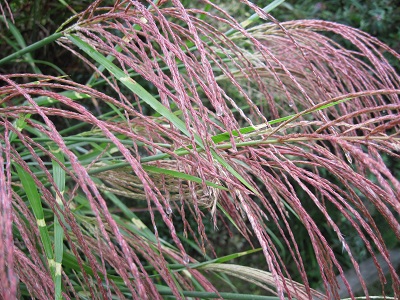
Can grass bloom? Sure it can! Most ornamental grasses bloom in the late summer and fall. Their blooms are plumes of  white or reddish bronze feathery tops.

 porcupine grass in bloom

This grass is called porcupine grass for the horizontal stripes on the blades. Also know as miscanthus sinesis strictus.

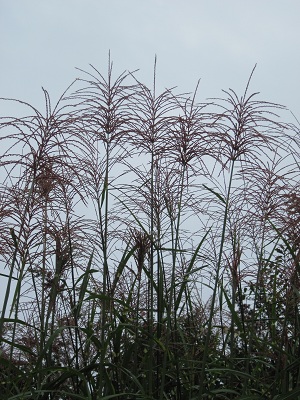
Plumes reach for the sky

In late fall, the grass plant begins with turn brown and wither a bit, but the plume stays upright through the winter months. That is when the grasses also make a rustling sound in the wind, while the plumes wave above. That sound reminds me of the beach in the winter.

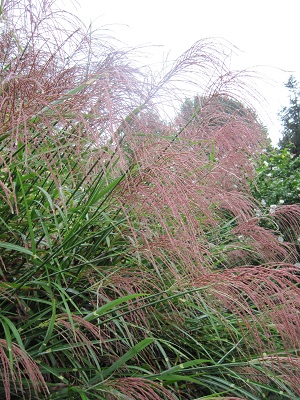
Miscanthus in the morning

I often include glasses in my seashore paintings. They grow along many beaches on the edge of the sand. Adding them to the paintings adds a bit of texture and greenery to break up the tans and blues of the sky, sea, and sand.

The Great Tomato Escape

Posted in Musing About Art, and Reference Photos

The Great Tomato Escape

What in the world? I opened the blinds this morning to see this….. 

tomato on gate

A not quite ripe tomato hanging on out on the gate handle.  Some blemishes, but no bite marks,  just hanging out.  I'm guess a squirrel hauled it up there on to the perfect eating platform.. Either that or the tomato was on it's way to jumping the gate for the Great Tomato Escape…. 

This would make for a odd  painting. Lots of contrasts: soft tomato, hard wood gate, dull gate, bright colorful tomato….Would the more philosophical among us read symbolism into a painting of a tomato on a gate handle?  Or would it just be a weird painting? Or could I turn into a children's art by painting it in a  whimsy style and creating a story around it? Or take it in the opposite direction and lean it into a Salvador Dali like surreal art ? Something to think about……   : )    Have a wonderful weekend!

Finally… Tomatoes

Posted in Reference Photos

Finally… Tomatoes

After battling poor soil, and every creature this side of the Mississippi, we have tomatoes!  Ok…. two tomatoes!   We have success with what the critters don't like to eat  – peppers, chives, squash of all kinds. But for some reason,  we can not get a tomato inside before someone snacks on it. Apparently tomatoes in our yard are the equivalent to chocolate cake  –  gone in a jiffy!  I picked these a little early before they disappeared. They'll finish  ripening  up in the window sill for a day or two.

Here they are!  I like photographing fruits and vegetables on a white surface. It keeps the focus on the subject and really shows the shadows, highlights, and details.  These guys are now on my very long list of painting ideas. 

Solving A Painting That Is Not Working, Part 2

Posted in Art Work, and Peeking Behind the Easel

Solving A Painting That Is Not Working, Part 2

 I suggested several steps yesterday to take when you can't figure out why a painting isn't working. For this painting, even turning it upside down wasn't getting me to what the problem was.  So luckily for me, my family was here. Family – especially teens and young 20's will tell you the truth – even when you didn't ask them.   : )

My family was curious how I could  fix the imbalance after they noticed the problem.  Since they were interested I got them involved in step 1 – brainstorm how to fix it.   With my chalk – step 2 – I sketched out on the painted canvas our ideas. [ Chalk is great  – it doesn't disturb the painting and wipes right off. ]    We tried adding more sunflowers, more details on the pumpkins, pumpkin leaves and vines from the stems, until someone blurted out turning it into a jack- 0-lantern.  Whoa!….. that was not at all what I had been thinking. 

But you know what?  It worked. It balanced the painting and added a light note to the painting to match the color palette I had chosen.  Here's the chalked idea:
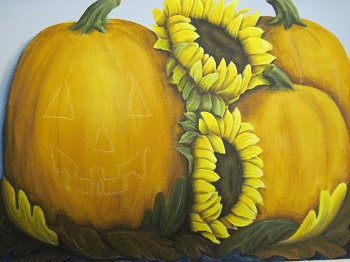
Using chalk to try out details on a painting

And here's the final painting after also adding a final tint on the pumpkins and photographing in natural light:
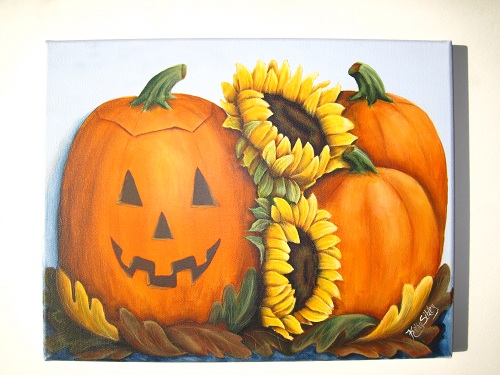
I had envisioned an Indian summer day for this painting, picking a light palette of colors rather than the usual darker colors used in pumpkin paintings. Adding a face to the pumpkin kept a lightness in the painting in addition to balancing out a composition error.  In a roundabout way, that's where the painting ended up – a warm, Indian summer day in early October.

What do you think?